
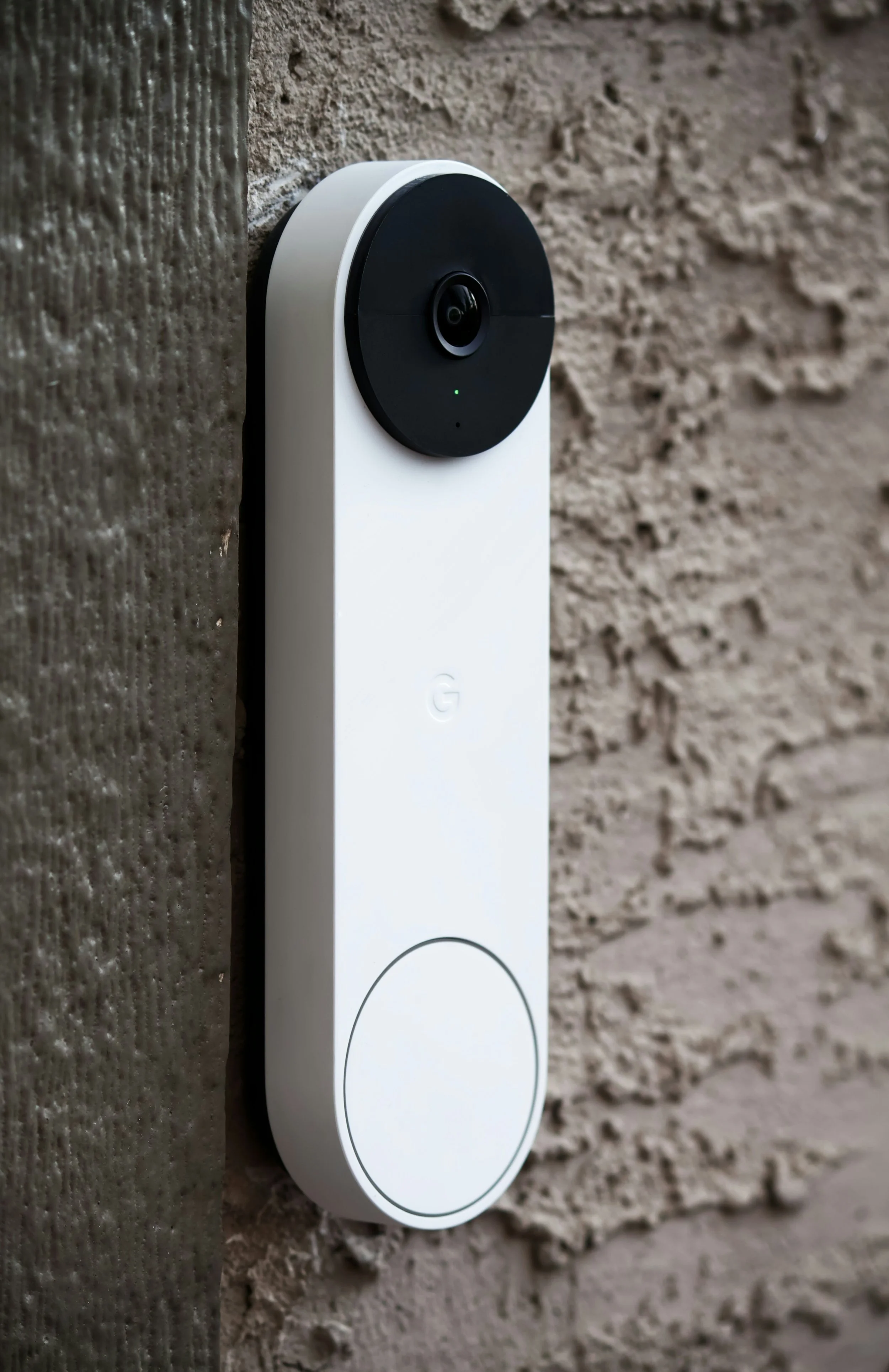
Video doorbell vs CCTV is a choice more and more homeowners are facing, and the two are often talked about as if they do the same job. They do not. A video doorbell is built to show you who is at the front door. A professionally installed CCTV system is built to watch over your property, record what happens and keep that footage safe.
This showdown puts the two head to head over seven rounds, from front-door convenience to privacy. It also covers which one suits which kind of home, what to ask before you buy and the rules you need to follow. The privacy points are checked against the Information Commissioner’s Office (ICO) guidance on home CCTV, so you can decide with confidence.
The quick verdict
Choose a video doorbell if your main aim is to see and speak to visitors and keep an eye on deliveries.
Choose professionally installed CCTV if you want to cover more of your property and rely on steady, dependable recordings.
Many homes do best with both: a doorbell for the front door and CCTV for everything else.
Either way, if a camera captures a neighbour’s property or a public area, data protection law applies.
Not sure which suits your property? Book a free site survey and an engineer will visit, look at your property and recommend a suitable set-up. GMSE Fire & Security installs CCTV for homes and businesses across Kent, London and East Sussex.
In this guide
The contenders: video doorbell and home CCTV
The video doorbell. A doorbell with a camera built in, fitted at the front door. When someone presses the button or movement is detected, it alerts your phone, and you can see and speak to the visitor from wherever you are. Some models run on a battery, others connect to the existing doorbell wiring, and most connect to your home Wi-Fi.
Professionally installed home CCTV. One or more cameras fitted where they are needed and linked to a recorder, with live and recorded footage you can view on your phone, tablet or TV. A system can be as small as a single front-door camera or cover the whole property, including the driveway and perimeter.
Round 1: Convenience at the front door
Winner: video doorbell.
This is where the video doorbell shines. It shows you who is at the door and lets you talk to them without opening it, whether you are in the next room or miles away. You can see a delivery arrive, check on an unexpected knock and answer a visitor when your hands are full. Many models are also quick to fit.
CCTV can cover the front door as well, but a standard system is not built around answering it. If speaking to visitors is your main reason for buying, a doorbell does that job better.
Round 2: Coverage
Winner: CCTV.
A video doorbell has one viewpoint, fixed at the front door. It shows you who comes to the door, but not what is happening down the side of the house, in the back garden or around a garage or shed.
CCTV is planned around your property. Cameras can be placed to cover the front door, driveway, side access and garden, so you can follow what is happening across more than one view. If your home has more than one way in, that wider coverage is the biggest difference between the two.
Round 3: Picture quality and night-time footage
Winner: CCTV, usually.
Picture quality depends on the individual model and the lighting as much as on the type of device, and many video doorbells now record in high definition. The difference is control. A doorbell has a fixed lens designed to show a wide view of a doorstep. With CCTV, the camera and lens can be chosen for each location: a wide view for a garden, a tighter one to pick out detail across a driveway.
Night vision varies too. Whichever you are considering, ask to see sample footage from the same camera in the dark before you commit.
Round 4: Reliability
Winner: CCTV, usually.
Many video doorbells depend on a battery, on Wi-Fi, or both. If the Wi-Fi signal at your front door is weak or your broadband goes down, alerts can be delayed and clips can be missed, depending on the model. Battery models also need to be recharged or replaced.
Wi-Fi jammers, sometimes called Wi-Fi blockers, are a further risk. They are devices that swamp the wireless signal so that nearby Wi-Fi devices cannot connect to the router, and the UK government has linked them to burglars disabling video doorbells and other home security systems. Depending on the model, a Wi-Fi camera that is jammed may send no alert and may not save or send its footage. A camera cabled to a recorder is not affected in the same way, because it does not depend on a radio signal to record.
A CCTV system with cameras cabled to a recorder does not rely on your Wi-Fi to record. You will still need an internet connection to watch footage remotely, but the recording carries on without it. Wired systems are generally more reliable for long-term use, especially in larger homes, while wireless cameras are easier to fit and suit smaller areas or temporary set-ups.
Round 5: Recording and storage
Winner: CCTV, usually.
Video doorbells commonly store clips in the cloud or on a memory card, and many start recording when they detect movement or when the button is pressed. That is useful for checking who called, but depending on the settings you may only get a short clip rather than the full picture of what happened before and after.
Home CCTV typically records to a recorder in your home and can be set up to record continuously or when movement is detected. Most systems keep footage for between 7 and 30 days, depending on the set-up and the storage capacity.
Round 6: Tamper resistance and deterrence
Winner: CCTV, usually.
A video doorbell sits at door height, within easy reach, so it can be covered, knocked or removed. CCTV cameras can be mounted higher, with cabling kept out of sight, and they can be either visible as a deterrent or discreet, depending on what suits your home.
On deterrence, the evidence is worth knowing about. A review of 40 years of research (Piza and colleagues, 2019) found that CCTV was linked to a modest but significant fall in crime, with the clearest effects in car parks. The effects were larger where footage was actively monitored and where CCTV was combined with other measures. That research looked at CCTV schemes in places such as car parks, rather than at doorbell cameras, and independent research on doorbell cameras specifically is much more limited.
The sensible conclusion is that neither device is a guarantee. Cameras work best alongside good locks, lighting and, where it suits, an intruder alarm. Our guide to whether burglar alarms are worth it explains more.
Round 7: Privacy and the law
Result: a draw.
Both devices follow the same rules. The ICO’s guidance on home CCTV covers fixed cameras and smart doorbells, and the principle is simple. Where possible, position cameras to capture only your own property. If a camera also captures someone else’s property, a public area or a communal space, data protection law applies, because other people’s images and voices count as their personal information.
In that case, the ICO says you should:
have a clear reason for using the camera and not capture more than you need, including audio
let people know, for example with a sign
store footage securely, so that only the people who need to see it can
delete footage regularly or automatically
respond to requests for footage from people who appear in it, usually within one calendar month
stop recording a person who objects, unless there is a legitimate reason to continue
A doorbell that faces a shared path, the pavement or a neighbour’s door can easily fall into this category, so check the angle when you set it up and use privacy filters or blockers if your camera has them. The ICO also says its home CCTV guidance is under review following changes made by the Data (Use and Access) Act, so check the latest version before you rely on it. If you are thinking of sharing footage online, read our guide on whether you can share CCTV on social media.
The scorecard
| Round | Video doorbell | Professionally installed CCTV | Edge |
|---|---|---|---|
| 1. Front-door convenience | See and speak to visitors easily | Shows the door, but not built around answering it | Video doorbell |
| 2. Coverage | One viewpoint at the front door | Cameras placed where you need them | CCTV |
| 3. Picture quality | Fixed lens, varies by model | Camera and lens chosen for each location | CCTV, usually |
| 4. Reliability | Often relies on battery, Wi-Fi or both | Cabled to a recorder, records without Wi-Fi | CCTV, usually |
| 5. Recording and storage | Often short clips in the cloud or on a card | Recorder on site, continuous or on movement | CCTV, usually |
| 6. Tamper resistance and deterrence | Within easy reach at the door | Can be mounted higher, visible or discreet | CCTV, usually |
| 7. Privacy and the law | ICO rules apply if it captures beyond your property | The same rules | A draw |
The video doorbell wins the round it was designed for, CCTV takes most of the security rounds and privacy is level. That does not make the doorbell a poor choice, only a different one.
Pros and cons
Video doorbell
Pros
See and speak to visitors from anywhere
Handy for deliveries and unexpected callers
Often quick and simple to fit
Cons
One viewpoint, so limited coverage
May depend on Wi-Fi, a battery or both
Not designed to protect the whole property
Susceptible to Wi-Fi blockers
Professionally installed CCTV
Pros
Cameras placed to cover the areas that matter
Camera and lens chosen for each location
Recording that does not depend on Wi-Fi when cabled to a recorder
Can be mounted out of reach, and either visible or discreet
Cons
More involved to fit, because cameras are positioned and cabled
Needs planning so that cameras do not capture more than they should
Not built around answering the door
Which one suits your home?
A flat or terraced house with one main entrance. A video doorbell may be all you need if your main aim is to see visitors and deliveries.
A detached house, or one with side access, a long drive or outbuildings. CCTV gives coverage a doorbell cannot, including areas that are out of sight of the front door. The same goes for rural homes in Kent with barns, sheds or land.
A home that has had a break-in, an attempted break-in or repeated parcel theft. Cameras covering the approach and the delivery spot give a clearer picture than a doorbell alone. Our guide to how CCTV helps prevent parcel theft covers this in more detail.
A rented home. Check your tenancy agreement and ask your landlord before you drill or fit anything permanent.
A home that wants the best of both. Use a video doorbell to answer the question “who is at the door?” and CCTV to answer “what is happening around the property?”
Questions to ask before you decide
Where will each camera be placed, and what will it be able to see? Will any camera capture a neighbour’s property or a public area?
Is the system wired or wireless, and what happens to recordings if the internet goes down or the power is cut?
Where is the footage stored, how long is it kept, who can view it and which features are included or optional?
Can I see sample footage from this camera at night?
Who will service the system, and how often?
The final verdict
Video doorbell vs CCTV is not really a contest between two versions of the same thing. A video doorbell is a convenient way to see and speak to whoever is at the door. Professionally installed CCTV is a way to watch over your property and keep a dependable record of what happens.
If you only need the first, a doorbell is a sensible choice. If you need the second, or you want both, plan the system around your property rather than one doorway. Whichever you choose, check what each camera can see, because your neighbours’ privacy matters as much as your own security.
To talk it through, book a free site survey or find out more about our CCTV installation service across Kent, London and East Sussex.
Frequently asked questions
-
Neither is better in every way. A video doorbell is better for seeing and speaking to visitors. CCTV is better for covering more of your property and for dependable recordings. Which is right depends on what you want the camera to do.
-
A video doorbell watches one point, the front door, and it is mainly designed for visitors and deliveries. If your home has side access, a back garden, a driveway or outbuildings, it will not show you what is happening there. Pairing a doorbell with CCTV, and with an alarm where it suits, gives a fuller picture.
-
Yes. The two do different jobs, so they work well together. A doorbell covers the front door and CCTV covers the rest of the property.
-
For data protection purposes, the ICO’s guidance on home CCTV covers both fixed cameras and smart doorbells, so the same thinking applies. If a camera captures someone else’s property, a public area or a communal space, data protection law applies.
-
The ICO says that if a camera captures someone else’s property, a public area or a communal space, data protection law applies, and you should let people know that CCTV is in use, for example with a sign. Check what your camera can see, including at the edges of its view.
-
Many can, but sound is personal information too. The ICO says that other people’s voices count as their personal information, and that you should consider whether you need to capture audio at all rather than capture more than you need. Check the settings on your device.
-
There is far less independent research on doorbell cameras than on CCTV, so it is hard to say. A review of 40 years of CCTV research found a modest fall in crime overall, but that covers CCTV schemes rather than doorbells. Visible cameras may help, but they work best alongside good locks, lighting and, where it suits, an alarm.
About this guide. Last checked in November 2026. This is a plain-English guide, not legal advice. The privacy points summarise the ICO’s guidance on home CCTV, which the ICO says is under review. It draws on:
Piza, Welsh, Farrington and Thomas (2019), CCTV Surveillance for Crime Prevention: A 40-Year Systematic Review with Meta-Analysis, Criminology & Public Policy, volume 18, issue 1