

Wireless Fire Alarm Systems for Kent, London & East Sussex.
No cable runs · No drilling · Perfect for listed buildings, period homes & rental properties across Kent, London & East Sussex
How Wireless Fire Alarms Work
Unlike traditional hardwired systems, wireless fire alarms communicate between devices using radio frequency signals rather than physical cables. Each detector, call point, and sounder is battery-powered and transmits its status to the control panel via an encrypted radio signal.
-

Radio Frequency Communication
Every device on the system communicates with the control panel wirelessly - typically on a dedicated frequency band to avoid interference from other wireless devices in the building.
-

Self-Monitoring Network
Modern wireless fire alarm systems continuously monitor the signal strength and battery status of every device. If a device loses signal or a battery runs low, the control panel raises a fault alert automatically.
-

Mesh Networks for Larger Buildings
For larger properties, wireless systems can operate as a mesh network. Devices communicate with each other as well as the control panel, extending the range and improving reliability across the building.
When Wireless is the Right Choice
-

Listed Buildings & Heritage Properties
Planning restrictions and the need to preserve historic fabric mean that drilling through walls and chasing cables is often not permitted in listed buildings. Wireless fire alarm systems require no cable runs whatsoever - making them the only viable professional option for many heritage properties.
-
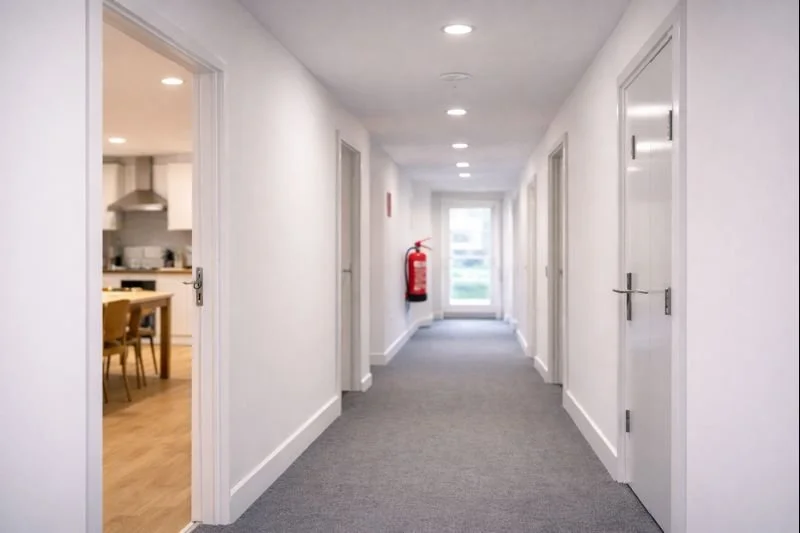
Rental Properties
Landlords and tenants in rental properties often can't or don't want to carry out invasive installation work. A wireless system can be installed and later removed or relocated with minimal impact on the property - ideal for both landlords and letting scenarios.
-

Quick Installations
When fire protection is needed urgently, for a new business opening, a temporary event space, or a property changing use, wireless systems can be installed in a fraction of the time of a hardwired equivalent.
-

Properties With Limited Cable Access
Older properties, buildings with solid stone walls, or premises where routing cables would be prohibitively disruptive are ideal candidates for wireless systems - no structural work required.
Wireless vs Hardwired: Which is Right for Your Property?
Both wireless and hardwired fire alarm systems are fully BS5839-compliant and equally reliable. The right choice depends on your property type and circumstances.
| Wireless | Hardwired | |
|---|---|---|
| Installation disruption | Minimal — no drilling or cable runs | Higher — cables chased or surface-mounted |
| Best for | Listed buildings, rentals, period properties | New builds, loft conversions, renovations |
| Reliability | Excellent — self-monitoring with fault alerts | Excellent — permanently powered |
| Maintenance | Battery replacement required | Battery backup only — mains powered |
| Flexibility | Easily relocated or expanded | Fixed installation |
Not sure which system is right for your property? Our engineers will advise at your free survey — no obligation.
Are Wireless Fire Alarms BS5839 Compliant?
Yes — absolutely. This is the most common misconception about wireless fire alarm systems. Modern wireless fire alarms are fully compliant with BS5839 Part 1 for commercial premises and BS5839 Part 6 for domestic premises. The standard governs the performance and reliability of the system — not how the devices communicate with each other.
-
Independently Tested & Certified
All wireless fire alarm systems installed by GMSE are independently tested and certified to BS5839 standards. The system performs to exactly the same standard as a hardwired equivalent - it simply communicates differently.
-
Accepted by Insurers
A wireless fire alarm system installed by a BAFE-certified company to BS5839 standards is accepted by insurers in the same way as a hardwired system. The certification of the installer and the standard of the installation are what matter, not whether cables are present.
-
Accepted by Fire Authorities
The Fire and Rescue Authority does not distinguish between wireless and hardwired systems when assessing compliance. What matters is that the system is appropriate for the premises and installed to the correct standard.
Battery Life & Maintenance
The most common concern about wireless fire alarm systems is battery life. Modern wireless fire alarm devices use highly efficient low-power radio technology, and battery life has improved significantly in recent years.
Typical Battery Life: Most wireless fire alarm devices have a battery life of between 2 and 5 years, depending on the device type, activation frequency, and manufacturer. Your control panel will issue a low battery alert well in advance of failure, giving you plenty of time to arrange a replacement.
Automatic Fault Monitoring: The control panel continuously monitors the battery status of every device on the system. If any device reports a low battery or signal fault, the panel raises an alert immediately — so nothing goes unnoticed between service visits.
Battery Replacement at Service Visits: GMSE monitors battery status during every scheduled maintenance visit and replaces batteries proactively where needed. This is included as standard in all maintenance contracts — you don't need to track battery ages yourself.
Frequently Asked Questions
-
Yes — modern wireless fire alarm systems are as reliable as hardwired equivalents. The system continuously monitors the signal strength and battery status of every device, raising an automatic fault alert if anything requires attention. All systems installed by GMSE are tested and certified to BS5839 standards.
-
Yes — wireless fire alarm systems can be connected to a professional 24/7 monitoring centre in exactly the same way as a hardwired system. The wireless element refers to how the detectors communicate with the control panel — not how the panel communicates externally.
-
Most wireless fire alarm devices have a battery life of between 2 and 5 years depending on device type and usage. The control panel monitors battery status continuously and raises a low battery alert well in advance of failure. GMSE replaces batteries proactively during scheduled maintenance visits.
-
Yes — one of the key advantages of a wireless system is flexibility. Additional detectors, call points, or sounders can be added to the system without any cable work. This makes wireless systems ideal for properties that may change in layout or use over time.
Get a Free Wireless Fire Alarm Survey
Our BAFE-certified engineers cover Kent, London & East Sussex. Whether you have a listed building, a period property, or a rental property where drilling isn't an option, we'll find the right wireless fire alarm solution for you.