
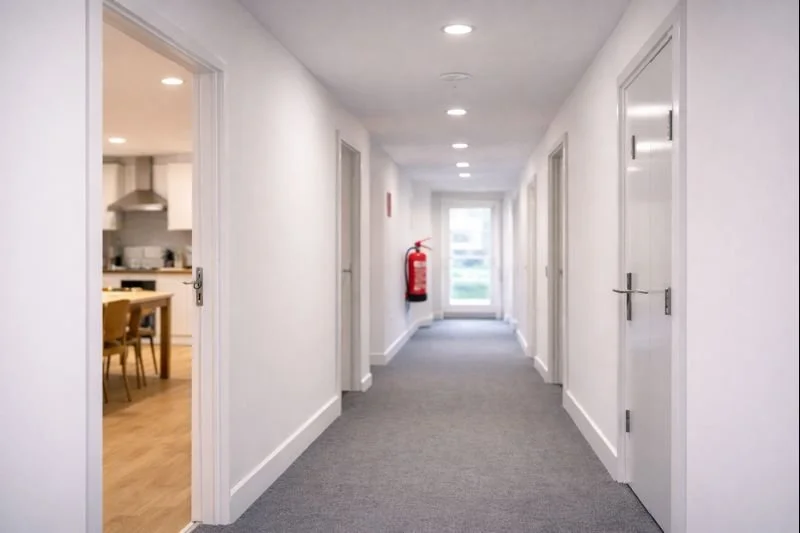
Providing Fire & Security for Landlords & HMOs
Stay compliant, protect your tenants, protect your licence, across Kent, London & East Sussex.
Your Legal Obligations as a Landlord
As a landlord, you have specific legal obligations regarding fire safety and security in your rental properties. These obligations vary depending on the type of property you let — but ignorance of the law is not a defence, and the consequences of non-compliance can be severe.
Smoke & Carbon Monoxide Alarm (Amendment) Regulations 2022
Require smoke alarms on every floor used as living accommodation and carbon monoxide alarms in all rooms containing a fixed combustion appliance. Applies to all private rented properties - not just HMOs. Landlords must test alarms at the start of every new tenancy.
Housing Act 2004
Gives local authorities the power to assess and enforce housing standards - including fire safety - through the Housing Health and Safety Rating System (HHSRS). Properties with serious fire hazards can be subject to improvement notices, prohibition orders, and civil penalties.
LACORS Housing Fire Safety Guidance
The primary reference document used by local authority licensing teams when assessing fire safety in HMOs. Sets out what detection, alarm systems, emergency lighting, and escape route provisions are expected for different property types.
Smoke & Carbon Monoxide Alarm Regulations 2022
The Smoke and Carbon Monoxide Alarm (Amendment) Regulations 2022 updated the rules for private landlords in England. These regulations apply to all private rented properties, not just HMOs, and came into force on 1 October 2022.
-

Smoke Alarms on Every Floor
A smoke alarm must be installed on every floor of the property that is used as living accommodation. This includes floors used only as bedrooms or living rooms, not just floors with kitchens or high-risk areas.
-

Carbon Monoxide Alarms in Every Room with a Combustion Appliance
A carbon monoxide alarm must be present in every room containing a fixed combustion appliance, such as a gas boiler, gas fire, or solid fuel burning appliance. This requirement now extends to gas boilers, which were previously excluded.
-

Testing at the Start of Every Tenancy
Landlords must test all smoke and carbon monoxide alarms at the start of each new tenancy and confirm they are in working order. Tenants are responsible for testing during the tenancy.
-

Repair and Replacement Obligations
If a tenant reports a faulty alarm, the landlord must repair or replace it as soon as reasonably practicable. Failure to do so can result in a remedial notice from the local authority.
Fire Safety Requirements for HMOs
Houses in Multiple Occupation have stricter fire safety requirements than standard rental properties. The specific requirements for your HMO depend on its size, layout, number of occupants, and whether it requires a licence from your local authority.
Grade D: Interlinked Smoke Alarms
The minimum requirement for smaller HMOs. Mains-powered or sealed battery interlinked smoke alarms, with detection in all rooms used as sleeping accommodation and in circulation areas on each floor. When one alarm activates, all alarms sound throughout the property.
Grade C: Mixed System
A combination of mains-powered smoke alarms and a central control panel. Required for larger or higher-risk HMOs where a more robust detection system is needed beyond simple interlinked alarms.
Grade A: Full BS5839 System
A full fire alarm system installed to BS5839 Part 1 standards. Required for larger licensed HMOs, properties converted into bedsits, and any HMO where the risk level indicates a higher standard of protection is needed.
The correct grade for your property depends on its specific layout, size, number of storeys, and number of occupants. GMSE engineers will assess your property and recommend the appropriate system at your free survey.
In addition to fire alarms, larger HMOs may also require emergency lighting in escape routes, fire doors on certain rooms, and specific fire extinguisher provision. A fire risk assessment will identify all requirements for your specific property.
Security Systems for Rental Properties
Beyond fire safety, landlords increasingly install security systems in rental properties to protect the building fabric, deter criminal damage, and satisfy insurance requirements. GMSE installs security systems designed specifically for rental property scenarios.
-

Wireless Alarm Systems
Wireless intruder alarm systems are ideal for rental properties where invasive cabling is impractical or where tenants change regularly. The system can be installed with minimal disruption and, if necessary, relocated or removed without damage to the property.
-

CCTV for Communal Areas
For HMOs and apartment blocks, CCTV covering communal entrances, stairwells, and external areas provides both a deterrent and evidence in the event of damage or antisocial behaviour. Systems are designed in line with ICO guidance for shared residential spaces.
-

Stockroom & Delivery Areas
Internal cameras covering stockrooms, staff areas, and delivery bays - protecting high-value stock and monitoring access to areas where employee theft is most likely to occur.
GMSE's Complete Landlord Compliance Service
GMSE provides a complete fire and security compliance service for landlords across Kent, London and East Sussex. Whether you have a single rental property or a portfolio of HMOs, we can survey, install, certify, and maintain everything you need in one straightforward package.
-

Fire Safety Survey
We visit your property, assess the layout and occupancy, and recommend the correct fire alarm grade and any additional requirements under LACORS guidance.
-
Compliant Installation
We install your fire alarm system to the correct grade and standard for your property type, with full documentation provided for your licensing application or renewal.
-

Fire Risk Assessment
For HMOs and larger properties, a BAFE-certified fire risk assessment identifies all hazards, evaluates risks, and provides a prioritised action plan for achieving compliance.
-

Compliance Certificate
Every installation comes with a completion certificate confirming the system meets the required standard, accepted by local authority licensing teams across Kent, London and East Sussex.
-
Smoke & CO Alarm Compliance
We supply and install smoke and carbon monoxide alarms meeting the 2022 Regulations, tested and documented at installation for your records.
-

Ongoing Maintenance
Annual inspection and maintenance contracts keep your systems compliant, your records up to date, and your licence protected throughout the tenancy.
Frequently Asked Questions
-
Yes, in most cases. All HMOs that require a licence must have a current fire risk assessment under the Regulatory Reform (Fire Safety) Order 2005. Even for smaller HMOs that don't require a mandatory licence, a fire risk assessment is strongly recommended and may be required by your local authority's additional licensing scheme. GMSE's BAFE-certified assessors can carry out your assessment and provide a written report with a prioritised action plan.
-
The correct grade depends on the size, layout, and type of your HMO. Smaller HMOs typically require a Grade D interlinked system as a minimum. Larger licensed HMOs may require a Grade A system installed to BS5839 standards. GMSE engineers will assess your property and confirm the correct grade at your free survey, taking into account your local authority's specific requirements.
-
No, not every room. Under the Smoke and Carbon Monoxide Alarm (Amendment) Regulations 2022, a carbon monoxide alarm is required in every room containing a fixed combustion appliance, such as a gas boiler, gas fire, or solid fuel burning appliance. This does not include rooms with gas cookers, but does include rooms with gas boilers, which was a change introduced by the 2022 regulations.
-
Failing to meet fire safety requirements can result in licence refusal or revocation, enforcement notices, and in serious cases, prosecution. Tenants in an unlicensed HMO can also apply for a Rent Repayment Order requiring the landlord to repay up to 12 months of rent. Acting early to ensure compliance is always less costly than dealing with enforcement action after the fact.
-
Yes. Every GMSE fire alarm installation and fire risk assessment comes with a completion certificate confirming the work meets the required standard. These certificates are accepted by local authority licensing teams across Kent, London and East Sussex and can be submitted directly with your licence application or renewal.
Get Your Landlord Fire Safety Survey
Our BAFE-certified engineers cover Kent, London and East Sussex. Whether you have a single rental property or a portfolio of HMOs, we'll assess your fire safety requirements, recommend the correct system, and provide everything you need for your licensing application or renewal.
Or call us on 01580 467070