
HMO Fire Safety Requirements: A Guide for Landlords (2026)
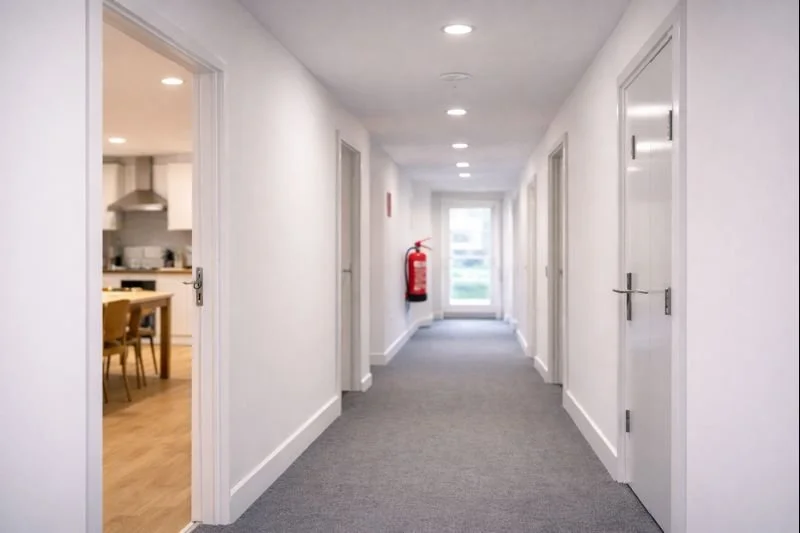
If you own or manage a House in Multiple Occupation (HMO), fire safety is not something you can leave to chance. The law places clear, specific obligations on landlords, and failing to meet them can result in unlimited fines, prosecution, and in the most serious cases, imprisonment. More importantly, getting it wrong puts lives at risk.
This guide covers everything HMO landlords need to know about fire safety requirements in 2026, from fire alarm grades and fire risk assessments to fire doors, signage, and what happens during a local authority inspection.
Looking for professional HMO fire safety installation?
Book a free survey with GMSE Fire & Security →
Table of Contents
What is an HMO?
HMO stands for House in Multiple Occupation. A property is classified as an HMO when it is occupied by three or more people from more than one household who share facilities such as a kitchen or bathroom.
Standard HMOs are occupied by three or more tenants from more than one household and are subject to the Housing Act 2004 and the Smoke and Carbon Monoxide Alarm (Amendment) Regulations 2022 as a minimum.
Mandatory licensed HMOs are properties occupied by five or more people from more than one household over three or more storeys. These require a mandatory HMO licence from the local authority, with fire safety compliance as a core licensing condition.
Some local authorities also operate additional or selective licensing schemes that extend requirements to smaller HMOs. Always check with your local council whether your property requires a licence.
The Legal Framework for HMO Fire Safety
HMO fire safety obligations come from several overlapping pieces of legislation.
The Regulatory Reform (Fire Safety) Order 2005 applies to communal areas of HMOs including hallways, stairwells, and shared kitchens. It requires a responsible person to carry out a fire risk assessment, implement appropriate measures, and keep them maintained.
The Housing Act 2004 gives local authorities power to assess and enforce housing standards through the Housing Health and Safety Rating System (HHSRS). Fire is classified as a Category 1 hazard, meaning authorities can take enforcement action if your property poses a serious risk.
The Smoke and Carbon Monoxide Alarm (Amendment) Regulations 2022 require smoke alarms on every floor used as living accommodation and carbon monoxide alarms in rooms containing a fixed combustion appliance. These apply to all privately rented properties, not just HMOs.
LACORS Housing Fire Safety Guidance is not legislation in itself, but it is the primary reference document used by local authority licensing teams when assessing fire safety in HMOs. GMSE engineers design all HMO fire alarm installations in line with LACORS guidance.
Fire Risk Assessments for HMOs
A fire risk assessment is a legal requirement for the communal areas of all HMOs under the RRO 2005. For larger licensed HMOs, local authorities typically expect a written assessment to be available for inspection.
The assessment must identify all fire hazards and people at risk, evaluate the level of risk, record findings, implement an action plan, and be reviewed regularly when circumstances change.
For most HMO landlords, using a BAFE certified assessor is the most practical approach, as their findings carry weight with local authority inspectors and insurers. The most common findings in HMOs include inadequate fire detection, missing or damaged fire doors, obstructed escape routes, and absent or expired fire extinguishers.
Fire Alarm Requirements for HMOs
Fire alarm requirements for HMOs are graded under BS 5839 Part 6. The correct grade depends on the size, layout, number of storeys, and number of occupants in your property.
Grade D: Interlinked mains-powered smoke alarms
Grade D is the minimum requirement for most smaller HMOs. Alarms are interlinked so that when one activates, all alarms sound throughout the property. Smoke detection is required on every floor used as living accommodation and in circulation areas. A heat detector rather than a smoke detector is required in the kitchen to reduce false alarms from cooking.
Grade C: Mixed system
A combination of mains-powered smoke alarms and a central control panel, required for larger or higher-risk HMOs.
Grade A: Full BS 5839 Part 1 system
A full addressable or conventional fire alarm system required for larger licensed HMOs, properties converted into bedsits, and any HMO where the risk assessment indicates a higher level of protection is needed.
GMSE engineers will assess your property and recommend the appropriate grade at your free survey.
Professional servicing is required at least once a year for Grade D systems and at least twice a year for Grade A systems.
Fire Doors in HMOs
Fire doors are one of the most frequently failing elements of HMO fire safety. A fire door is not simply a heavy door. It is a complete assembly including the frame, hinges, intumescent strips, and a self-closing mechanism, all of which must be present and working.
LACORS guidance recommends fire doors on all rooms that open onto an escape route. In practice, this typically means all bedroom doors, the kitchen door opening onto a hallway or stairwell, and doors to any high-risk areas such as boiler rooms or storage cupboards. All fire doors must be self-closing.
Fire doors degrade over time. Intumescent strips dry out, gaps open around the frame, and hinges loosen. As a landlord, you are responsible for ensuring fire doors are maintained in serviceable condition throughout every tenancy.
Emergency Lighting Requirements
LACORS guidance recommends emergency lighting in escape routes in larger HMOs and licensed properties. Properties with three or more storeys should have emergency lighting as standard. It must activate automatically on mains power failure, remain operational for a minimum of one hour, and be tested monthly with an annual full-duration test.
Fire Extinguishers in HMOs
For most smaller HMOs, fire extinguishers are not a mandatory requirement in every room. A fire blanket in the kitchen is recommended as standard. For larger licensed HMOs, fire extinguishers in communal areas are typically expected by local authority inspectors. The correct specification should be determined by your fire risk assessment
Fire Safety Signage
As a minimum, HMOs must display fire action notices at every alarm call point, an assembly point sign at the designated gathering area, fire exit signs on all escape routes, and fire door signs on all fire doors. All signage must use ISO 7010 compliant symbols and be maintained in a legible condition throughout every tenancy.
Carbon Monoxide Alarms
Under the 2022 Regulations, a carbon monoxide alarm must be installed in every room containing a fixed combustion appliance, including gas boilers. This requirement was extended to include gas boilers by the 2022 amendment, which caught many landlords off guard. Alarms must be tested at the start of every new tenancy, and any faulty alarm must be repaired or replaced as soon as reasonably practicable.
What Happens During an HMO Licensing Inspection?
When you apply for or renew an HMO licence, your local authority will inspect the property. The fire safety inspection will typically cover whether a fire risk assessment is available, the grade and condition of the fire alarm system, the condition of fire doors and whether they are self-closing, emergency lighting coverage, fire safety signage, and whether carbon monoxide alarms are installed in all required rooms.
If the property fails to meet the required standard, the local authority can refuse to grant or renew the licence. Operating a licensable HMO without a licence is a criminal offence carrying an unlimited fine. Tenants can also apply for a Rent Repayment Order requiring repayment of up to 12 months of rent.
Common Mistakes HMO Landlords Make
Not updating the fire risk assessment after changes to the property. Structural alterations, changes in occupancy, or changes in the use of rooms all trigger a requirement to review the assessment.
Fire doors that are not self-closing. Self-closing devices fail over time and must be checked and replaced as part of routine property maintenance.
Interlinked alarms that are not actually interlinked. Alarms replaced individually by tenants may not be interlinked with the rest of the system. Always check after any alarm is replaced.
Assuming Grade D is sufficient for all HMOs. Larger or higher-risk properties require a more sophisticated system. A professional installer who understands LACORS guidance will ensure the correct grade is specified.
Not testing alarms at the start of a new tenancy. The 2022 Regulations specifically require landlords to test smoke and carbon monoxide alarms at the start of every new tenancy.
Conclusion
HMO fire safety is not a one-off exercise. It requires active management throughout every tenancy. A BAFE certified fire risk assessment, a correctly graded and installed alarm system, well-maintained fire doors, and the right signage and detection throughout the property will satisfy most local authority inspectors and give your tenants the protection they are entitled to.
Find out more about GMSE's complete landlord fire safety service →
Book your free HMO fire safety survey →
FAQs
-
A fire risk assessment is a legal requirement for the communal areas of all HMOs under the Regulatory Reform (Fire Safety) Order 2005. It must identify fire hazards and people at risk, evaluate the level of risk, and produce a written record with an action plan. It must be reviewed regularly and updated when circumstances change. For licensed HMOs, the local authority will typically expect to see a written assessment during the licensing inspection.
-
Not necessarily. The correct specification depends on the size, layout, and risk level of your property. For most smaller HMOs, a Grade D interlinked smoke alarm system is the minimum, with detection in all sleeping accommodation and circulation areas, and a heat detector in the kitchen. Larger or higher-risk HMOs may require a Grade A full BS 5839 system. Your fire risk assessment will determine the correct grade.
-
The most significant recent change is the Smoke and Carbon Monoxide Alarm (Amendment) Regulations 2022, which extended the requirement for carbon monoxide alarms to include rooms containing a gas boiler. The Building Safety Act 2022 also introduced stronger enforcement powers and a requirement to record fire safety arrangements in full.
-
For most smaller HMOs, fire extinguishers are not a mandatory requirement in every room. A fire blanket in the kitchen is recommended as standard. For larger licensed HMOs, fire extinguishers in communal areas are typically expected by local authority inspectors. The correct specification should be determined by your fire risk assessment.
-
There is no single fire safety certificate for HMOs in England. However, a BAFE certified fire risk assessment provides documented evidence of compliance, and every fire alarm installation should come with a commissioning certificate. These are the documents local authority licensing teams and insurers will ask to see.
-
LACORS guidance recommends fire doors on all rooms that open onto an escape route. In practice, this means all bedroom doors, the kitchen door opening onto a hallway or stairwell, and doors to high-risk areas such as boiler rooms. All fire doors must be self-closing and maintained in serviceable condition throughout every tenancy.
-
As a minimum, HMOs should display fire action notices at every alarm call point, an assembly point sign at the designated gathering area, fire exit signs on all escape routes, and fire door signs on all fire doors. All signage must use ISO 7010 compliant symbols and be maintained in a legible condition.